Explaining to members how to access their K-1's
Linda,
If you are suggesting that the gain/loss from the sale of partnership units must be divided into short-term and long-term components, that's incorrect. The gain is all short-term or long-term based on the length of time since the date the member joined the club. A partnership interest is a unitary interest, it's not treated like the purchase of stock or a mutual fund.
Ira Smilovitz, EA
On Mon, Feb 20, 2017 at 2:28 AM, Linda Wiltse <wiltse@optonline.net> wrote:
[Portions deleted]
There are several ways to calculate the short and long term portions of gain or loss. You can do it by unit allocations or cost allocations. It is too complex to go into here.
Linda
Pointe Players treasurer
Do you have documentation that supports that theory? If so I would like to see it because it would save me work if that is true.
From: club_cafe@bivio.com [mailto:club_cafe@bivio.com] On Behalf Of ira smilovitz
Sent: Monday, February 20, 2017 9:02 AM
To: club_cafe@bivio.com
Subject: Re: [club_cafe] Explaining to members how to access their K-1's
Linda,
If you are suggesting that the gain/loss from the sale of partnership units must be divided into short-term and long-term components, that's incorrect. The gain is all short-term or long-term based on the length of time since the date the member joined the club. A partnership interest is a unitary interest, it's not treated like the purchase of stock or a mutual fund.
Ira Smilovitz, EA
On Mon, Feb 20, 2017 at 2:28 AM, Linda Wiltse <wiltse@optonline.net> wrote:
[Portions deleted]
There are several ways to calculate the short and long term portions of gain or loss. You can do it by unit allocations or cost allocations. It is too complex to go into here.
Linda
Pointe Players treasurer

|
This email has been checked for viruses by Avast antivirus software.
|
Ira,
I'm interested in your reply to Linda. My club is about to do a partial withdrawal for all our members by distributing a large LTCG from the sale of a stock. However, altho' one partner has only been a member since April 2016, the withdrawal report classifies hers as LTCG. I have the nagging suspicion that hers should be STCG, but (a) I don't know what to base such a change on, and (b) I don't see any easy way to do so in bivio.
Perhaps the simple solution is to delay her partial withdrawal to May 2017?
From: ira smilovitz <ira.smilovitz@gmail.com>
To: "club_cafe@bivio.com" <club_cafe@bivio.com>
Sent: Monday, February 20, 2017 7:02 AM
Subject: Re: [club_cafe] Explaining to members how to access their K-1's
Linda,
If you are suggesting that the gain/loss from the sale of partnership units must be divided into short-term and long-term components, that's incorrect. The gain is all short-term or long-term based on the length of time since the date the member joined the club. A partnership interest is a unitary interest, it's not treated like the purchase of stock or a mutual fund.
Ira Smilovitz, EA
On Mon, Feb 20, 2017 at 2:28 AM, Linda Wiltse <wiltse@optonline.net> wrote:
[Portions deleted]
There are several ways to calculate the short and long term portions of gain or loss. You can do it by unit allocations or cost allocations. It is too complex to go into here.LindaPointe Players treasurer
I don't have the documentation at my fingertips, but it follows from the treatment of partial withdrawals. A partial withdrawal is a return of capital until the partner's entire cost basis is recovered. If you had to track the holding period of investment club units, each partial withdrawal would be a capital transaction with gain/loss tied to the cost basis of the specific units liquidated. (FIFO or specific identification).
Here's a link to an old piece written by Rip West about this:
I'm trying to locate the rest of the articles.
Ira Smilovitz, EA
On Mon, Feb 20, 2017 at 11:50 AM, Linda Wiltse <wiltse@optonline.net> wrote:
Do you have documentation that supports that theory? If so I would like to see it because it would save me work if that is true.
From: club_cafe@bivio.com [mailto:club_cafe@bivio.com] On Behalf Of ira smilovitz
Sent: Monday, February 20, 2017 9:02 AM
To: club_cafe@bivio.com
Subject: Re: [club_cafe] Explaining to members how to access their K-1's
Linda,
If you are suggesting that the gain/loss from the sale of partnership units must be divided into short-term and long-term components, that's incorrect. The gain is all short-term or long-term based on the length of time since the date the member joined the club. A partnership interest is a unitary interest, it's not treated like the purchase of stock or a mutual fund.
Ira Smilovitz, EA
On Mon, Feb 20, 2017 at 2:28 AM, Linda Wiltse <wiltse@optonline.net> wrote:
[Portions deleted]
There are several ways to calculate the short and long term portions of gain or loss. You can do it by unit allocations or cost allocations. It is too complex to go into here.
Linda
Pointe Players treasurer
This email has been checked for viruses by Avast antivirus software.
www.avast.com
Boyd,
I suspect you're doing something wrong, but I don't know what. The sale of the stock should be a long-term capital gain for the club which will be reported on the appropriate year's 1065. The distributions of cash to the members will be returns of capital (no tax impact) for those members whose tax basis is larger than the amount of cash they receive. For those who receive more cash than their tax basis, the excess cash will be short-term/long-term based on their entry date into the club.
That said, you won't know for sure how much excess cash was distributed to a member until the end of the tax year. Their tax basis will include all income/expense items for the year as well as any member deposits made before the end of the year.
If you send a request to support@bivio.com, someone will review the specific transactions in your club's records.
Ira Smilovitz
On Mon, Feb 20, 2017 at 12:18 PM, A Hinds via bivio.com <user*28730700001@bivio.com> wrote:
Ira,I'm interested in your reply to Linda. My club is about to do a partial withdrawal for all our members by distributing a large LTCG from the sale of a stock. However, altho' one partner has only been a member since April 2016, the withdrawal report classifies hers as LTCG. I have the nagging suspicion that hers should be STCG, but (a) I don't know what to base such a change on, and (b) I don't see any easy way to do so in bivio.Perhaps the simple solution is to delay her partial withdrawal to May 2017?
From: ira smilovitz <ira.smilovitz@gmail.com>
To: "club_cafe@bivio.com" <club_cafe@bivio.com>
Sent: Monday, February 20, 2017 7:02 AM
Subject: Re: [club_cafe] Explaining to members how to access their K-1's
Linda,If you are suggesting that the gain/loss from the sale of partnership units must be divided into short-term and long-term components, that's incorrect. The gain is all short-term or long-term based on the length of time since the date the member joined the club. A partnership interest is a unitary interest, it's not treated like the purchase of stock or a mutual fund.Ira Smilovitz, EAOn Mon, Feb 20, 2017 at 2:28 AM, Linda Wiltse <wiltse@optonline.net> wrote:[Portions deleted]There are several ways to calculate the short and long term portions of gain or loss. You can do it by unit allocations or cost allocations. It is too complex to go into here.LindaPointe Players treasurer
Bivio Support has reviewed our distribution; we just didn't discuss this issue.
Since the club has existed since 1997, all the members' tax bases are far in excess of the partial withdrawal we're contemplating, even the new member's. It's just that because she's only been a member since April 2016, I wondered if it was an error for her partial withdrawal to be classified as LTCG.
I wonder if the simple solution is to do her withdrawal in May 2017, at which point she'd have been a member for more than one year, presumably making this whole question moot..
----- Forwarded Message -----
From: ira smilovitz <ira.smilovitz@gmail.com>
To: "club_cafe@bivio.co
Sent: Monday, February 20, 2017 10:33 AM
Subject: Re: [club_cafe] Explaining to members how to access their K-1's
Boyd,
I suspect you're doing something wrong, but I don't know what. The sale of the stock should be a long-term capital gain for the club which will be reported on the appropriate year's 1065. The distributions of cash to the members will be returns of capital (no tax impact) for those members whose tax basis is larger than the amount of cash they receive. For those who receive more cash than their tax basis, the excess cash will be short-term/long-term based on their entry date into the club.
That said, you won't know for sure how much excess cash was distributed to a member until the end of the tax year. Their tax basis will include all income/expense items for the year as well as any member deposits made before the end of the year.
If you send a request to support@bivio.com, someone will review the specific transactions in your club's records.
Ira Smilovitz
On Mon, Feb 20, 2017 at 12:18 PM, A Hinds via bivio.com <user*28730700001@bivio.com> wrote:
Ira,I'm interested in your reply to Linda. My club is about to do a partial withdrawal for all our members by distributing a large LTCG from the sale of a stock. However, altho' one partner has only been a member since April 2016, the withdrawal report classifies hers as LTCG. I have the nagging suspicion that hers should be STCG, but (a) I don't know what to base such a change on, and (b) I don't see any easy way to do so in bivio.Perhaps the simple solution is to delay her partial withdrawal to May 2017?
From: ira smilovitz <ira.smilovitz@gmail.com>
To: "club_cafe@bivio.com" <club_cafe@bivio.com>
Sent: Monday, February 20, 2017 7:02 AM
Subject: Re: [club_cafe] Explaining to members how to access their K-1's
Linda,If you are suggesting that the gain/loss from the sale of partnership units must be divided into short-term and long-term components, that's incorrect. The gain is all short-term or long-term based on the length of time since the date the member joined the club. A partnership interest is a unitary interest, it's not treated like the purchase of stock or a mutual fund.Ira Smilovitz, EAOn Mon, Feb 20, 2017 at 2:28 AM, Linda Wiltse <wiltse@optonline.net> wrote:[Portions deleted]There are several ways to calculate the short and long term portions of gain or loss. You can do it by unit allocations or cost allocations. It is too complex to go into here.LindaPointe Players treasurer
How do I send K-1's to a withdrawn member?
Print the applicable K-1 pages for the withdrawn member to a .pdf file using Microsoft Print to PDF and email it or print paper copies and send via USPS mail. Include the Withdrawal Report with the K-1.
Scott
Sent from my iPhone
> On Feb 27, 2026, at 1:54 PM, Portia Catania via bivio.com <user*22765200001@bivio.com> wrote:
>
> How do I send K-1's to a withdrawn member?
Scott
Sent from my iPhone
> On Feb 27, 2026, at 1:54 PM, Portia Catania via bivio.com <user*22765200001@bivio.com> wrote:
>
> How do I send K-1's to a withdrawn member?
If they no longer have access to your club's bivio site, you need to print the K-1 and deliver it to them. Ask Support and they may have other suggestions.
Ira Smilovitz
How do I send K-1's to a withdrawn member?
Here are the instructions I send to club members who all have access to bivio
Log into bivio using your id and password
Click on Accounting
Click on Taxes
Scroll down to Step 8
Click on view my Schedule K forms
Choose 2025 Federal K Form
It will be a pdf document
Open and print it
On Friday, February 27, 2026 at 12:54:44 PM CST, Portia Catania via bivio.com <user*22765200001@bivio.com> wrote:
How do I send K-1's to a withdrawn member?
My members are having difficult locating the "My K-1"
selection. Possible next year, it could be at top of form?
Most of my members are not tech savvy, and don't realize
they have to scroll further down. Of course, being
treasurer, don't see the page they are seeing. Thnx
selection. Possible next year, it could be at top of form?
Most of my members are not tech savvy, and don't realize
they have to scroll further down. Of course, being
treasurer, don't see the page they are seeing. Thnx
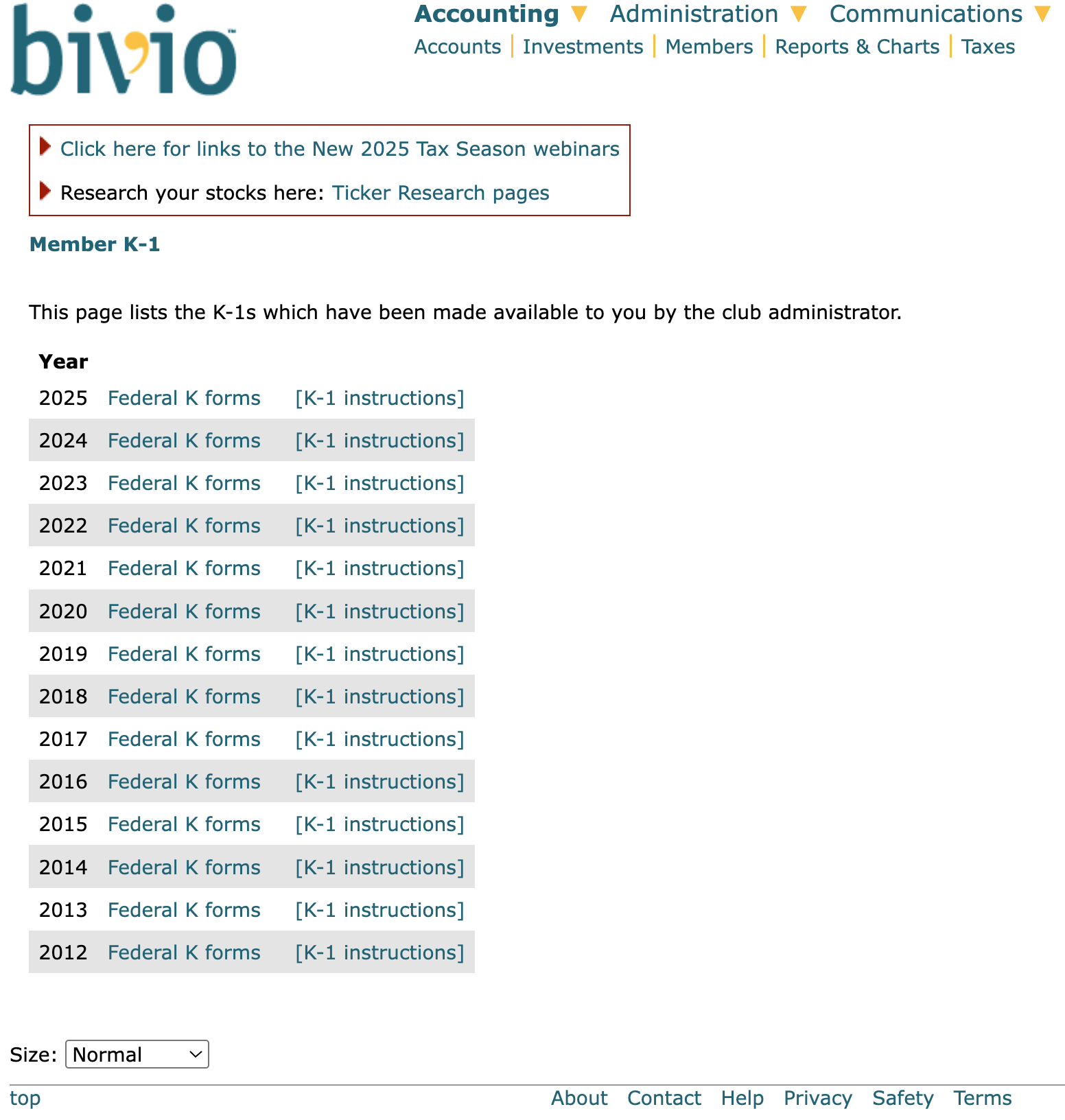
Note that members that are not club officers have a
different view when they go to Accounting > Taxes. They do
not see steps 1 - 8, they only see links to their own K-1
forms. See the attached screen shot for an example.
Justin
bivio Support
different view when they go to Accounting > Taxes. They do
not see steps 1 - 8, they only see links to their own K-1
forms. See the attached screen shot for an example.
Justin
bivio Support
Thanks, it was hard to instruct them , when I didn’t know whaat they were seeing
> On Mar 2, 2026, at 5:37 PM, bivio Customer Support <support@bivio.com> wrote:
>
> Note that members that are not club officers have a
> different view when they go to Accounting > Taxes. They do
> not see steps 1 - 8, they only see links to their own K-1
> forms. See the attached screen shot for an example.
>
> Justin
> bivio Support
> <bivio-member-k1-list.png>
> On Mar 2, 2026, at 5:37 PM, bivio Customer Support <support@bivio.com> wrote:
>
> Note that members that are not club officers have a
> different view when they go to Accounting > Taxes. They do
> not see steps 1 - 8, they only see links to their own K-1
> forms. See the attached screen shot for an example.
>
> Justin
> bivio Support
> <bivio-member-k1-list.png>
What I do is call one of our members who is tech savy and have her go to her K1. Then she tells me exactly what she sees and I send this information our to the rest of the members. Works for our club
Thanks, it was hard to instruct them , when I didn't know whaat they were seeing
> On Mar 2, 2026, at 5:37 PM, bivio Customer Support <support@bivio.com> wrote:
>
> Note that members that are not club officers have a
> different view when they go to Accounting > Taxes. They do
> not see steps 1 - 8, they only see links to their own K-1
> forms. See the attached screen shot for an example.
>
> Justin
> bivio Support
> <bivio-member-k1-list.png>